Managing Stiffness (Weeks 1–2)
How to Manage Stiffness After Knee Replacement (Weeks 1 and 2)
Your knee is supposed to feel like this right now.
Stiff. Warm. Tight, like the skin can barely hold it. If that's where you are in the first weeks after surgery, nothing has gone wrong. This is the part almost everyone hits, and it's a lot easier to get through once you know what's causing it and what helps.
I'm Diana Braun. I've been through this recovery twice, and I coach people through it now. What follows is what I learned firsthand, paired with the guidance of Dr. Raj Sinha, a board-certified orthopedic surgeon with nearly 30 years and more than 10,000 knee replacements behind him, and my co-author on Knee Replacement Secrets. Read more about us.
Why is my knee so stiff after surgery?
Two things, mostly. Dr. Sinha explains that the first is the operation itself. There's a lot of swelling in there, and swelling is what creates that stiff, tight feeling. The second is the implant. Knee implants have gotten remarkable over the last few decades, and Dr. Sinha helped design several of them, but they're still new hardware your body has to get used to. For a good stretch of your recovery, your body is busy adapting to the plastic and metal now inside your knee.
Put those together, the swelling and the adjustment, and you get stiffness, warmth, and tightness across the top of your knee and lower thigh. Dr. Sinha hears this description from patient after patient. I felt every bit of it myself. And no, you don't have to just sit there and take it. Here's what to do.
How do I manage the discomfort?
Two tools matter most: your medication and real rest.
Those first two weeks are the hard ones, because almost any movement stirs up swelling, and swelling is what makes you stiff. So your main job right now is to stay on a strict medication schedule and get ahead of the pain instead of chasing it. Timing my medications so they worked together, rather than waiting until I hurt, was one of the most useful things I did.
Your surgeon may include an opioid in that early plan. That word scares people, and I understand why. Here's how Dr. Sinha frames it. Used briefly, on schedule, and under your surgeon's direction, controlling pain hard in the first days sets up a smoother recovery, and the research shows people who stay ahead of the pain early tend to use less medication overall. You will taper off them, and your surgeon will guide when. Anything about your specific medications is a conversation for you and your care team.
Most of your pain control will come from a combination your doctor builds, often acetaminophen (Tylenol) paired with an anti-inflammatory like ibuprofen (Advil, Motrin) or naproxen (Aleve), and sometimes a prescription-strength anti-inflammatory instead. These work by calming the inflammation and quieting the pain signals right at the swollen knee. Taken on schedule, they treat the pain at its source. But even the right medication works best when you pair it with real rest.
What does proper rest look like?
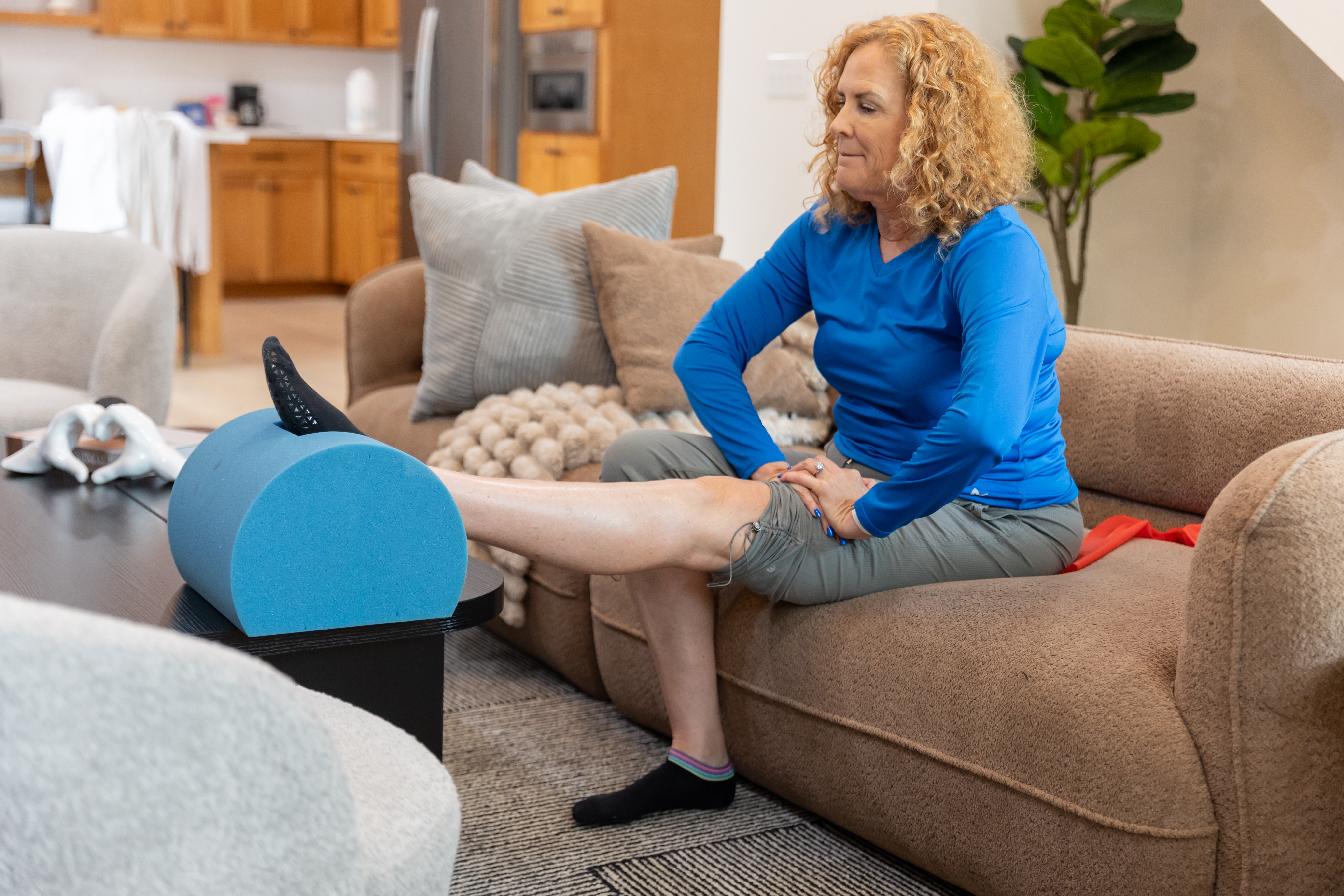
Beyond sleep, it comes down to two things: ice and elevate, and keeping that knee straight.
As I always say, ice is going to be your best friend. It brings the swelling down and takes the edge off the warmth. Keep a few packs in the freezer so a cold one is always ready. When you elevate, get your foot up above your nose, so a bed or a recliner is usually your best spot.
Now the part people get wrong. Dr. Sinha says keeping your leg straight is one of the most important things you can do this early. After surgery your knee wants to bend, and it feels good to slide a pillow under it. In his words, "that is a big no-no." Put the pillow under your heel instead, not your knee. Keep the leg long. The sooner you can keep it straight, the sooner your flexibility comes back and the pain eases. If your hamstrings ache, a heating pad back there can help.
The single most common mistake Dr. Sinha and I see: people elevate, but they tuck the pillow under the knee for comfort instead of under the ankle. That bends the joint right back up. Elevate and keep it straight. Do both.
What to expect from here
Once you've got a rhythm, keeping swelling down and staying ahead of the pain, that rhythm carries you through the rest of recovery. It puts you in the best spot to hit your physical milestones. You'll be eager to move on your new knee, and that's good, but don't push past your limit or you can set yourself back. Look at how far you've already come, and take it one step at a time.
You don't have to figure this out alone
Is this normal? That question runs on a loop at 2am, and stiffness is one people ask about most. It is normal, and it passes. We built The Knee Zone to meet you wherever you are on your knee journey and tell you what's normal at every stage.
Watch more from Diana and Dr. Sinha on YouTube.